
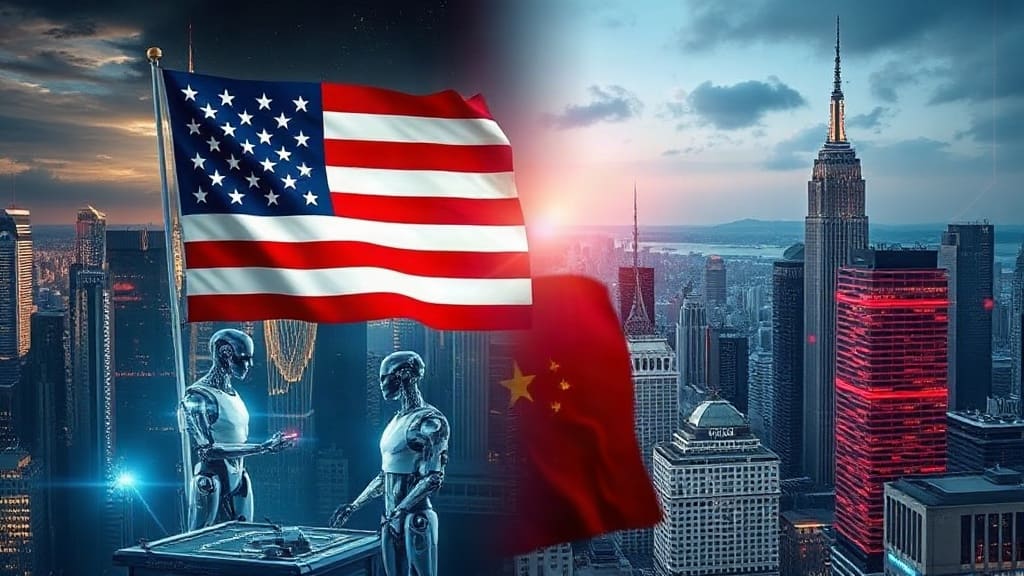
Artificial intelligence has become the defining technology of this decade, and with that status comes a fierce debate over how fast we should move. On one side, researchers and ethicists warn about existential risks, algorithmic bias, and job displacement. On the other, political and industry leaders argue that hesitation could cost the United States its competitive edge. The latest voice to join the latter camp is former President Donald Trump, who recently brushed aside dire warnings about AI, framing the issue almost entirely through the lens of rivalry with China.
Trump's remarks came during a public appearance where he addressed the growing chorus of caution from AI experts. According to reports, he referred to those raising concerns as "negative forces" and suggested they were focused on "things that won't happen." It was a blunt dismissal of a debate that has consumed Silicon Valley, Washington, and global regulatory bodies. But more than the dismissal itself, the framing was notable: Trump tied the AI risk conversation directly to economic and military competition with Beijing.
Why Trump's Comments Matter Right Now
At first glance, a former president's opinion on AI might seem like just another political soundbite. But in reality, it reflects a deepening divide in how policymakers think about technological progress. The Biden administration has taken a more cautious approach, introducing executive orders aimed at promoting safe and secure AI development. Meanwhile, a significant portion of the Republican base, including Trump, sees any regulatory slowdown as a gift to adversaries.
This isn't just about politics. The AI industry is watching closely because the regulatory environment will shape investment, research priorities, and the speed at which products reach the market. When a figure with Trump's influence says that warnings are overblown, it emboldens those who want minimal oversight. It also puts pressure on companies that have publicly committed to responsible AI to justify any self-imposed limits.
The China angle is particularly potent. For years, U.S. policymakers have warned that losing the AI race to China would have severe national security implications. Trump's argument is simple: if American companies slow down to address hypothetical risks, Chinese firms will sprint ahead. In his view, that's a risk far greater than any speculative doomsday scenario.
The Broader Debate: Risk vs. Reward in AI
The AI risk debate has evolved rapidly. Just a few years ago, public discussion centered on narrow applications like facial recognition or recommendation algorithms. Today, the conversation includes artificial general intelligence (AGI), autonomous weapons, and the potential for AI systems to manipulate information at scale. High-profile figures like Geoffrey Hinton and Yoshua Bengio, both Turing Award winners, have warned that advanced AI could pose risks comparable to nuclear weapons if not managed carefully.
Yet many in the tech industry and government argue that these warnings are premature or exaggerated. They point out that AI has already delivered enormous benefits in healthcare, logistics, and scientific research. They also note that the United States cannot afford to fall behind China, which has made AI a national priority and is investing heavily in both civilian and military applications.
Trump's comments tap into this tension, but they also oversimplify it. The choice is not between reckless speed and total paralysis. Many experts advocate for a middle path: continued innovation with targeted safeguards for high-risk applications. However, in a polarized political climate, nuance often gets lost.
What Would Slowing Down Actually Mean?
One of the most common proposals from AI safety advocates is a pause on training models more powerful than current frontier systems. The idea gained traction in 2023 with an open letter signed by thousands of researchers and tech leaders, including Elon Musk and Steve Wozniak. The letter called for a six-month moratorium to develop shared safety protocols.
Trump's response to such proposals is telling. He didn't engage with the technical arguments; instead, he framed the entire debate as a battle between American optimism and foreign competition. "We can't let China win," he said, echoing a theme from his presidency. For his supporters, that's a winning message. It's simple, patriotic, and dismissive of what they see as elite hand-wringing.
But critics argue that this framing ignores real risks that have already materialized. AI-generated disinformation has influenced elections, deepfakes have been used for fraud and harassment, and automated systems have made biased decisions in hiring and lending. These aren't hypothetical scenarios; they're happening now. The question is whether the pace of development should be tempered to address these issues, or whether the competitive advantage is simply too important to sacrifice.
The China Factor: More Than Just Rhetoric
China's AI ambitions are real and well-documented. The Chinese government has outlined a plan to become the world leader in AI by 2030, and it has backed that goal with massive funding. Chinese companies like Baidu, Alibaba, and Tencent are working on large language models and other advanced systems. The People's Liberation Army is also investing in AI for autonomous weapons, surveillance, and cyber operations.
From a national security perspective, the concern is that falling behind in AI could translate into military disadvantage. AI is expected to play a critical role in everything from intelligence analysis to drone swarms to cyber defense. If China achieves a significant lead, the United States could find itself vulnerable in ways that are hard to predict.
Trump's argument, therefore, has a kernel of truth. Slowing down AI development without a coordinated international agreement would indeed give China an opportunity to pull ahead. But the problem is that no such agreement exists, and the United States has limited leverage to force one. In that context, a unilateral pause could be strategically costly.
The Political Landscape and What Comes Next
Trump's comments are likely to resonate with a large segment of the Republican Party that is skeptical of regulation and eager to compete with China. They also put pressure on Democratic policymakers who are trying to balance innovation with safety. The result is a political environment where comprehensive AI legislation is difficult to pass, and where executive actions can be reversed with each change in administration.
For the tech industry, the message is mixed. On one hand, Trump's stance suggests that a future Trump administration would be friendly to AI development, with minimal regulatory hurdles. On the other hand, the lack of clear rules creates uncertainty. Companies need to know what standards they will be held to, and constant political whiplash makes long-term planning difficult.
Looking ahead, the AI debate is unlikely to be resolved anytime soon. The technology is advancing too quickly, and the stakes are too high. What Trump's comments reveal is that the conversation is not just about safety or ethics; it's about power, competition, and national identity. Those are forces that don't easily yield to reasoned argument.
Frequently Asked Questions
What exactly did Trump say about AI risks?
Trump dismissed AI risk warnings by calling those who raise them "negative forces" and suggesting they are focused on "things that won't happen." He framed the issue as a competition with China, implying that slowing down would hand Beijing an advantage.
Why does Trump believe AI warnings are exaggerated?
Trump's position is rooted in a broader skepticism of expert warnings and a strong belief in American competitiveness. He argues that the United States cannot afford to pause or slow AI development while China is moving full speed ahead.
What are the main risks that AI experts warn about?
Experts warn about a range of risks, including the potential for AI to be used in autonomous weapons, the spread of AI-generated disinformation, algorithmic bias, and the long-term possibility of artificial general intelligence that could act in ways that are hard to control.
How does China's AI development compare to the United States?
China has made AI a national priority and is investing heavily in research, talent, and infrastructure. While the United States still leads in many areas, the gap is narrowing, and China is particularly strong in areas like facial recognition and surveillance technology.
What would a pause on AI development mean for the tech industry?
A pause on training advanced AI models would slow the release of new products and features, potentially delaying benefits in areas like healthcare and scientific research. It would also give competitors, particularly in China, time to catch up or surpass American capabilities.