
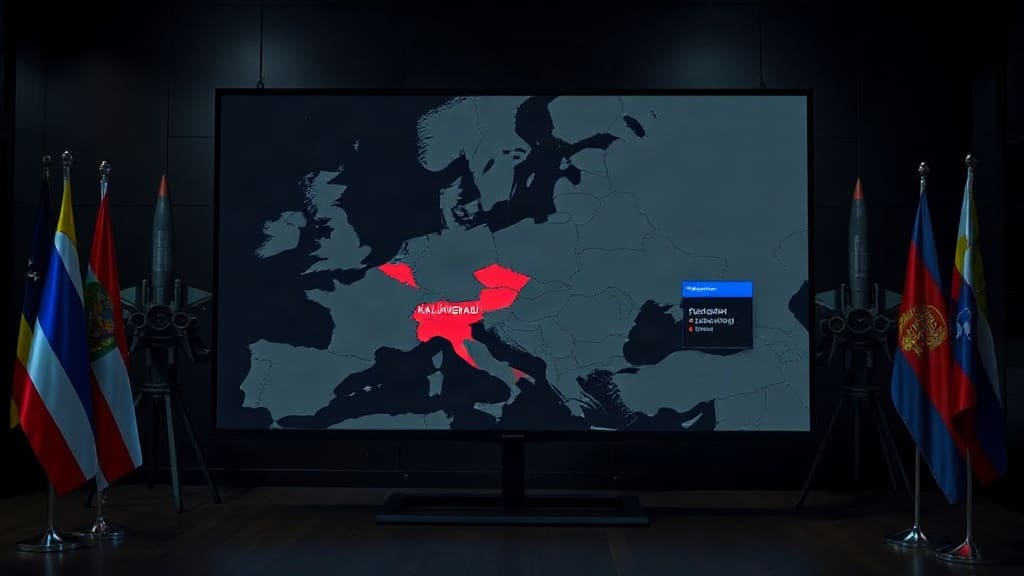
In a move that has startled diplomats and security analysts alike, Russia's embassy in London has issued a stark warning of nuclear conflict in response to a new British television drama. The program, titled The Wargame and aired by Sky, portrays a fictional scenario in which NATO launches a military strike on Kaliningrad, a heavily militarized Russian exclave nestled between Poland and Lithuania. The embassy's statement, released via social media and picked up by state news agencies, accused the West of warmongering and suggested that such portrayals could edge the world closer to a real nuclear confrontation.
The reaction underscores just how sensitive the Kremlin remains about its strategic outpost on the Baltic Sea, and how quickly cultural products can become fodder for geopolitical brinkmanship. While television dramas are typically dismissed as entertainment, in this case the line between fiction and propaganda has blurred, with Russian officials using the show to amplify long-standing grievances against NATO and the United Kingdom.
What the Embassy Actually Said
The Russian embassy's message was unambiguous. It claimed that the scenario depicted in The Wargame reflects a genuine planning assumption within NATO circles, and warned that any attack on Kaliningrad would be treated as an attack on the Russian homeland, warranting a nuclear response. The statement did not provide evidence for its assertion, but it echoed previous Kremlin rhetoric that any threat to its territory, including annexed regions, could trigger atomic retaliation.
Notably, the embassy did not specify what actions it might take. Instead, it leaned on implied menace, a tactic that has become familiar since the full-scale invasion of Ukraine in 2022. By framing a TV show as a provocation, Moscow appears to be testing the boundaries of what it can label as an existential threat, thereby justifying its own aggressive posture.
British officials have so far declined to comment directly on the embassy's statement, but government sources indicate that such threats are viewed as part of a broader pattern of Russian psychological operations. The UK has been one of Ukraine's most vocal supporters, supplying weapons and training, and has frequently been singled out by Russian state media as a prime adversary.
The Strategic Significance of Kaliningrad
To understand why a television plot could elicit such a fierce response, one must appreciate Kaliningrad's role in Russian military strategy. The exclave, which borders NATO members Poland and Lithuania, hosts the Baltic Fleet, advanced missile systems, and reportedly nuclear-capable Iskander missiles. It is a linchpin of Russia's ability to project power into the Baltic region and to potentially disrupt NATO supply lines in a crisis.
Any military action against Kaliningrad would therefore be seen in Moscow as a direct assault on core Russian interests. NATO, for its part, has long maintained that it has no offensive plans against the exclave, but the alliance has bolstered its eastern flank following Russia's actions in Ukraine. The tension is palpable, and a fictional portrayal of a strike taps into very real fears on both sides.
The drama's timing is also significant. It airs as the war in Ukraine grinds on, with no clear end in sight, and as NATO prepares for its largest military exercises in decades. In this context, even a work of fiction can be weaponized in the information war that accompanies the physical conflict.
Why Russia Uses Nuclear Rhetoric
Since the start of the invasion, Russian officials have repeatedly invoked nuclear weapons as a deterrent against Western intervention. These threats are widely interpreted as attempts to scare off further military support for Ukraine and to fracture Western unity. Yet they also serve a domestic purpose: by painting Russia as a besieged fortress, the Kremlin bolsters support for the war and deflects attention from battlefield setbacks.
The embassy's statement about The Wargame fits this pattern. It allows Moscow to portray the West as the aggressor, even as Russian forces continue to occupy Ukrainian territory. By reacting to a TV show, the embassy also signals that it monitors Western media closely and is willing to respond to perceived slights, however trivial they may seem.
Analysts caution that while the threat is likely bluster, the risk of miscalculation remains. In a tense environment, even rhetorical escalation can lead to unintended consequences. The incident serves as a reminder that the information space is now a battleground, and cultural products are not immune from geopolitical fallout.
The West's Response and Implications
So far, NATO and the UK have not officially responded to the embassy's threat. However, behind the scenes, officials are likely assessing whether this is a one-off propaganda move or part of a larger campaign. The UK's Ministry of Defence has previously accused Russia of conducting a campaign of disinformation and cyber attacks, and this latest episode will be seen as further evidence of Moscow's aggressive stance.
For the public, the controversy raises questions about the role of entertainment in shaping perceptions of conflict. The Wargame may have been intended as a thought-provoking drama, but it has now become a diplomatic incident. This blurring of lines is precisely what makes modern hybrid warfare so challenging: there is no longer a clear distinction between the battlefield and the airwaves.
The incident also highlights the importance of media literacy. In an era where state actors can seize on any narrative to advance their agenda, consumers of news and entertainment must be discerning. The Russian embassy's threat is a stark example of how a fictional scenario can be twisted into a real-world warning.
What to Watch Next
Moving forward, several factors will determine whether this remains a rhetorical skirmish or escalates further. First, the Kremlin's follow-up: will it summon the British ambassador or take other diplomatic measures? Second, NATO's response: will it adjust its messaging or military posture in the Baltic region? Third, the media's role: will other broadcasters shy away from sensitive topics, or will they double down on creative freedom?
For now, the embassy's threat appears to be another salvo in the ongoing information war. But it is a reminder that in the current climate, even a television drama can become a flashpoint. As tensions persist, the world watches to see whether art will continue to imitate life, or whether life will start imitating art in the most dangerous way possible.
Frequently Asked Questions
What is 'The Wargame' about?
The Wargame is a Sky television drama that depicts a fictional scenario in which NATO launches a military strike on Kaliningrad, a Russian exclave. The plot explores the escalation of tensions between Russia and the West, culminating in a nuclear crisis.
Why did Russia's embassy in London react so strongly?
The embassy's reaction reflects Russia's sensitivity about Kaliningrad, which hosts significant military assets. By framing the show as a provocation, Moscow aims to deter Western support for Ukraine and reinforce its narrative of being surrounded by hostile forces.
Has NATO actually planned an attack on Kaliningrad?
There is no public evidence that NATO has any plans to attack Kaliningrad. The alliance has consistently stated that it poses no threat to Russia and that its military posture is defensive, aimed at protecting member states.
How likely is a nuclear war over this?
Extremely unlikely. The embassy's statement is widely seen as rhetorical escalation rather than a concrete threat. However, the incident underscores the dangers of miscalculation in a tense environment, which is why experts urge continued dialogue and de-escalation.
What does this mean for UK-Russia relations?
Relations are already at a post-Cold War low. This episode will likely further strain diplomatic ties, but it is unlikely to lead to a direct military confrontation. The UK is expected to continue supporting Ukraine while dismissing Russian threats as bluster.