
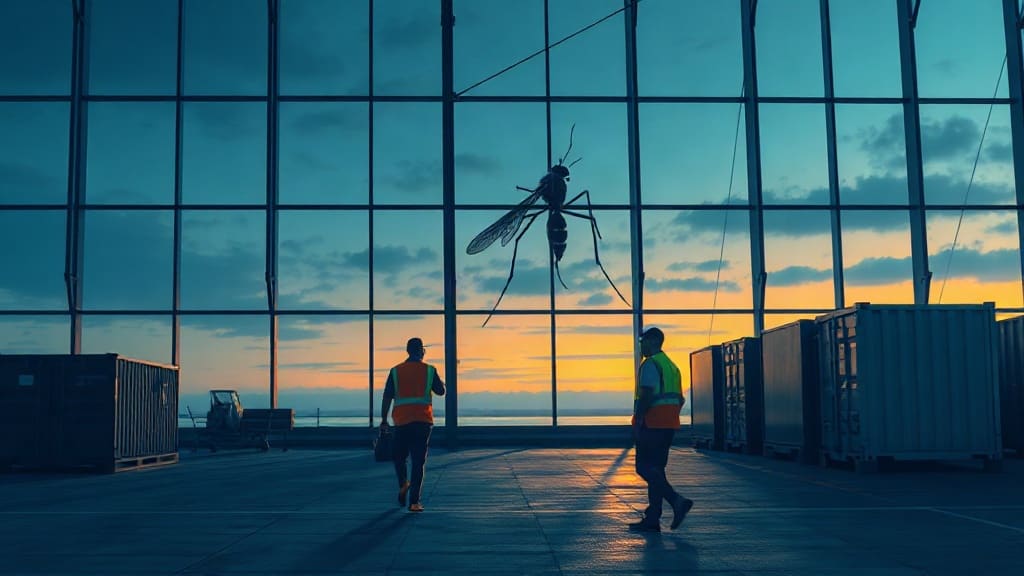
In a development that has startled public health experts and aviation workers alike, German health authorities have confirmed that six employees at Frankfurt Airport contracted malaria this past summer. Two of those workers died, marking an extraordinarily rare occurrence for a disease typically associated with tropical regions. The outbreak has raised urgent questions about how malaria could take hold in a major European transportation hub and what it means for the millions of passengers and staff who pass through the airport each year.
Malaria is a serious and sometimes fatal disease caused by parasites that are transmitted to humans through the bites of infected female Anopheles mosquitoes. It is not contagious between people, and in non-endemic areas like Germany, cases are almost always imported by travelers returning from regions where malaria is common. What makes the Frankfurt cluster so unusual is that none of the six infected employees had recently traveled to a malaria-endemic country. This has led investigators to focus on a chilling possibility: the mosquitoes that transmitted the disease may have arrived at the airport on an aircraft.
How the Frankfurt Airport Malaria Cases Unfolded
The first signs of trouble emerged in mid-summer when several airport workers began experiencing fever, chills, and flu-like symptoms. Because malaria is so uncommon in Germany, initial diagnoses were delayed. By the time blood tests confirmed the presence of Plasmodium parasites, two of the patients were already critically ill. Despite intensive medical care, they did not survive.
Health officials from the Robert Koch Institute, Germany's national public health agency, launched an immediate epidemiological investigation. They interviewed the infected workers, mapped their movements within the airport, and tested for mosquito breeding sites. All six individuals worked in different areas of the airport, but they shared one common factor: they spent significant time in and around cargo handling zones and aircraft maintenance areas.
The working hypothesis, now considered highly likely, is that an infected mosquito entered the airport aboard an arriving international flight. Once inside the climate-controlled terminal or adjacent facilities, the mosquito survived long enough to bite multiple people. Airports are known to provide surprisingly hospitable microclimates for insects, with warm temperatures, standing water from condensation or cleaning operations, and abundant human hosts.
Why Airport Malaria Transmission Is a Growing Concern
This is not the first time malaria has been linked to airport environments. The phenomenon, sometimes called "airport malaria" or "odyssean malaria," has been documented sporadically across Europe and North America for decades. However, most previous cases involved a single infection, not a cluster of six. The Frankfurt outbreak is one of the largest ever recorded outside an endemic region.
Several factors are converging to increase the risk of such events. Global air travel has rebounded strongly after the COVID-19 pandemic, with more flights arriving from sub-Saharan Africa, Southeast Asia, and South America, where malaria remains endemic. Climate change is also expanding the geographic range of Anopheles mosquitoes, and warmer temperatures allow the malaria parasite to develop more quickly inside the insect. Even in temperate regions, a mosquito that survives a transcontinental flight can potentially transmit the disease for several days.
Airports themselves are complex ecosystems. They contain numerous hidden spaces where mosquitoes can rest and breed: drainage channels, air conditioning ducts, luggage conveyor systems, and even potted plants in waiting areas. Once a mosquito is inside, traditional outdoor control measures like spraying and larvicide application are far less effective.
The Response from Health Authorities and Airport Operators
In the wake of the outbreak, Frankfurt Airport's operator, Fraport, implemented an emergency vector control program. This included intensified insect monitoring, targeted spraying in cargo and maintenance areas, and the installation of additional insect traps. Workers were advised to use insect repellent and wear long sleeves, particularly during evening and early morning shifts when mosquitoes are most active.
Local health departments also issued alerts to hospitals and clinics, urging doctors to consider malaria in any patient with fever and a history of working at or visiting the airport. Rapid diagnostic tests were made available to airport employees, and an information campaign was launched to raise awareness about symptoms and prevention.
Despite these measures, public health experts caution that eliminating the risk entirely is nearly impossible. Airports are porous environments, and the sheer volume of incoming aircraft makes it unfeasible to inspect every plane for insects. Some countries have experimented with residual insecticide treatment inside aircraft cabins and cargo holds, but such measures are controversial due to concerns about chemical exposure and potential effects on aircraft materials.
What Travelers and Workers Should Know
For the general public, the absolute risk of contracting malaria at a European airport remains extremely low. However, the Frankfurt cases underscore the importance of vigilance, especially for airport employees who spend long hours in operational areas. Symptoms of malaria typically appear 7 to 30 days after an infected mosquito bite and include high fever, shaking chills, headache, muscle aches, and fatigue. If left untreated, the disease can progress rapidly to severe complications, including organ failure and death.
Travelers returning from malaria-endemic regions should be particularly alert. Even if they took prophylactic medication, no regimen is 100% effective. Anyone who develops fever within a few months of returning from a tropical country should seek medical attention immediately and inform their doctor about their travel history.
Health authorities also recommend that airport operators in non-endemic countries review their vector surveillance protocols. Simple measures, such as eliminating standing water, sealing cracks and crevices, and maintaining insect screens on ventilation openings, can significantly reduce the likelihood of mosquito establishment. Training staff to recognize and report mosquito activity can also help catch problems early.
The Broader Implications for Global Health Security
The Frankfurt outbreak is a stark reminder that infectious diseases do not respect borders. In an increasingly interconnected world, the movement of people, goods, and even insects can introduce pathogens into new environments with surprising speed. While malaria is not a new disease, its appearance in an unexpected setting challenges assumptions about risk and preparedness.
This event also highlights the need for robust surveillance systems that can detect unusual disease patterns quickly. The delay in diagnosing the first Frankfurt cases likely contributed to the severity of the outbreak. In a world where malaria could become more common in temperate zones, healthcare providers must be trained to recognize the signs, even when the patient has no travel history.
For now, the immediate crisis at Frankfurt Airport appears to be contained. No new cases have been reported in recent weeks, and the vector control measures appear to be working. But the memory of two lost lives serves as a sobering reminder of the hidden dangers that can lurk in the most mundane of places.
Frequently Asked Questions
Can you get malaria from an airport in Europe?
Yes, although it is extremely rare. The recent cluster at Frankfurt Airport shows that infected mosquitoes can survive flights and transmit the disease inside airport facilities. However, the risk for the average traveler passing through an airport is very low.
What are the symptoms of malaria to watch for after traveling?
Symptoms include high fever, chills, sweating, headache, nausea, vomiting, and muscle pain. They usually appear between 7 and 30 days after a mosquito bite but can be delayed for months. If you have these symptoms after visiting a malaria-endemic area, seek medical care immediately.
How can airport workers protect themselves from malaria?
Workers should use insect repellent containing DEET or picaridin, wear long-sleeved clothing, and avoid standing water areas. Employers should implement mosquito surveillance and control programs, including eliminating breeding sites and using traps.
Is malaria contagious from person to person?
No, malaria cannot spread directly from one person to another. It is only transmitted through the bite of an infected female Anopheles mosquito. In rare cases, it can be transmitted through blood transfusion or organ transplant.
What is being done to prevent future airport malaria outbreaks?
Airports are increasing insect monitoring, applying targeted insecticides, and improving drainage to reduce mosquito breeding. Some are considering treating aircraft interiors with residual insecticides, though this remains controversial. Public health agencies are also enhancing surveillance and educating healthcare providers.