
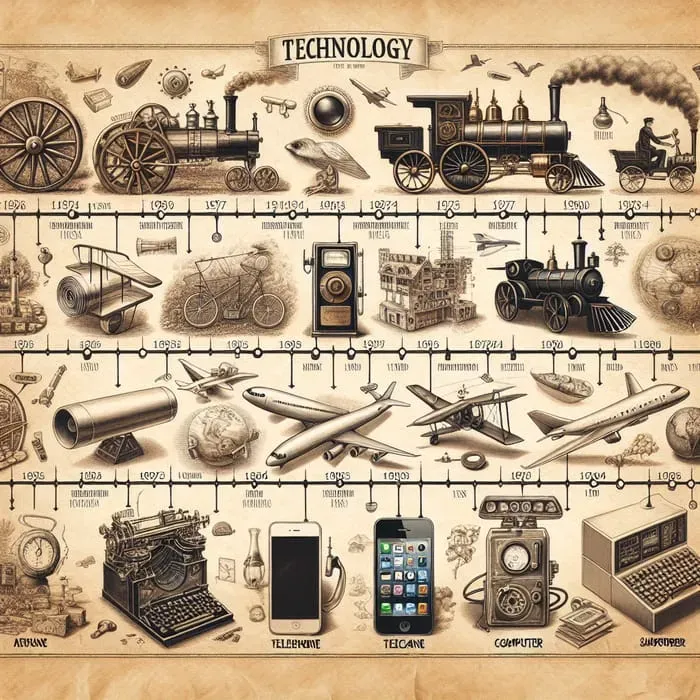
History of technology tells the story of humans turning ideas into tools that extend our senses, speed our work, and expand our reach. From the telegraph era to the transformative shifts of the industrial revolution, signals, wires, and machines compressed time and redefined global connectivity. These early leaps show how people organized knowledge and labor around new capabilities, laying groundwork for later computation and automation. That trajectory moves from curiosity to systems—where devices become parts of larger networks that store, transmit, and process information. As this evolving toolkit shapes economies, cultures, and everyday life, the story invites us to understand tomorrow with greater clarity.
Seen through another lens, this story traces the evolution of tools that extend human capacity, from simple signals to sophisticated, data-driven systems. It emphasizes networks, standards, and platforms that knit together devices, people, and ideas across borders, eras, and industries. Rather than focusing on a single invention, the tale centers on the ongoing flow of invention, adoption, and interoperability that keeps progress moving. In this framing, the digital age, automation, and intelligent systems are not isolated milestones but chapters in a larger, interconnected progression.
History of technology: From Telegraph Era to the Digital Revolution
From the telegraph era, signals traveled with a speed that shrank distances and reorganized society. Operators tapped Morse code across wires, turning simple electrical impulses into messages that could cross oceans in a fraction of the time a courier required. The telegraph era did more than move characters; it moved ideas, shaping finance, news, and diplomacy, while giving birth to a discipline of reliability: standardized time, clocks, cables, and schedules that kept a growing network in sync. In the broader narrative of the History of technology, the telegraph marks a turning point where communication becomes globally instantaneous and the world begins to feel more connected than before.
As cables multiplied and networks expanded, the telegraph era gave way to electrification, mass production, and the rise of integrated systems that could sense, store, and transmit information beyond simple wires. The electric power grid unlocked around-the-clock production; the telephone extended voice across the home; radio broadcast culture into communities far apart. This period shifted attention from standalone devices to networks and workflows—the industrial revolution extended into an electronic, information-driven era—where calculators, punched cards, and early computers began to integrate into laboratories and factories. The story of computing history begins when ideas about automation move from individual machines to scalable systems.
Over time, computing history shows information becoming a tangible commodity, enabling new business models and research practices. As systems scale, the distinction between tool and process blurs, and the digital revolution emerges as a continuation of this arc: from mechanized calculation to data-driven decision-making, from room-sized machines to personal devices and cloud platforms.
Artificial Intelligence and Computing History in the Digital Revolution
The digital revolution stands on the shoulders of earlier waves—microprocessors, networking, and software ecosystems that knit devices into an interconnected world. The computing history of this era shows how isolated machines become a shared infrastructure capable of storing, analyzing, and transmitting vast datasets at unprecedented speed, enabling smarter tools and more informed decision-making across sectors.
Artificial intelligence marks the latest leap, turning the promise of computation into systems that learn from data, recognize patterns, translate languages, and support decision-making across industries—from healthcare and finance to transportation and entertainment. In this light, artificial intelligence is not a single gadget but a family of methods that builds on the computing history, combining algorithms, hardware, and scalable data resources to amplify human capabilities.
Ethics, governance, and safety accompany AI's spread, inviting us to consider bias, transparency, accountability, and privacy in this new digital revolution. As AI-driven tools become more embedded in daily life and critical operations, the history of technology continues to unfold with a focus on responsible innovation, human-centric design, and the social choices that shape how technology serves public good as well as private gain.
Frequently Asked Questions
In the history of technology, how did the telegraph era transform global communication and set the stage for future innovations?
The telegraph era compressed time and space by transferring messages across continents, introducing synchronized clocks, standardized cables, and rapid news and finance. It showed that information could be a tangible commodity and demonstrated scalable, modular systems that influenced later developments in radio, telephone networks, and the early internet. This milestone in the history of technology laid the groundwork for computing history by proving that networks could extend human reach far beyond local limits.
What was the impact of the digital revolution on computing history and the rise of artificial intelligence?
The digital revolution, driven by microprocessors, memory, networking, and software, transformed how we work, learn, and connect, creating a global computing ecosystem. It enabled data-driven techniques, machine learning, and AI to move from theory to everyday applications, shaping industries from healthcare to transportation. In the computing history narrative, this era expanded capabilities and interoperability, with artificial intelligence becoming a central driver of progress.
| Section | Key Points |
|---|---|
| Introduction | Technology as human-made tools that extend senses, speed work, and expand reach; history spans centuries with a dramatic leap in the last 150 years as signals, circuits, and machines become everyday companions; a throughline from the telegraph to modern AI shows social, economic, and ethical currents guiding innovation. |
| The Telegraph Era | Groundwork for global connectivity; Morse code in the 1830s–1840s crossing continents; telegraph moves ideas as reliably as characters; prompts synchronized clocks, standardized cables, and timetables; marks the turning point when communication becomes instantaneous and the world feels more connected. |
| Industrial, Electrical, and Computing Transitions | Electrification, mass production, and growing information systems beyond wires; electric grid powers factories, telephone expands voice reach, radio knits distant communities, automation reshapes productivity; shifts from devices to integrated systems; a revolution in practice where calculators, punched cards, and early computers link computing with industry. |
| Computing History | From mechanical minds to electronic intelligence: Babbage’s ideas, Hollerith’s punched cards, and the move to vacuum tubes, transistors, and integrated circuits; room-sized machines give way to personal computers; the Internet turns isolated devices into a global information network, with software and hardware evolving together toward data, simulations, and AI. |
| Digital Revolution and the Internet | Late 20th-century shift to digital computing: microprocessors, portable devices, and software reshape work, learning, and creation; the Internet becomes the backbone for e-commerce, cloud computing, and digital media; cybersecurity and data privacy become essential; ecosystems of memory, networking, and platforms enable simulations, ML, and ubiquitous connectivity. |
| Artificial Intelligence | AI represents a major stage in technology history: theory and learning give way to systems that recognize patterns, translate languages, and act on data; modern AI, powered by ML, neural networks, and vast data, spans healthcare, finance, transport, and entertainment; ethical challenges around bias, transparency, accountability, and safety accompany progress. |
| Intersections, Impacts, and the Shape of the Future | Recurring themes: acceleration, globalization, openness vs. control; education and interdisciplinary literacy matter as breakthroughs rely on science, policy, and user understanding; future tech like quantum computing, robotics, and AI-driven systems demand bridging science with policy, ethics with engineering, and design with user experience. |
| A Look Ahead | Technology evolves in waves; the next decade will likely bring more capable AI, smarter devices, and broader networks that blur the line between physical and digital worlds; innovation will be guided by researchers, entrepreneurs, policymakers, and everyday users working to improve education, health, and the environment while balancing privacy and safety. |
| Conclusion: Reflecting on the Journey from Telegraph to AI | A concise synthesis of the journey shows that history is not just gadgets, but a tapestry of human ingenuity translating ideas into methods, systems, and cultures; breakthroughs build on one another through collaboration across disciplines, and enduring technologies are those that people can understand, trust, and use to live better lives. |
Summary
History of technology is a narrative of human curiosity and collective effort, weaving together tools, institutions, and ideas into the fabric of daily life. From the telegraph to AI, the journey traces how breakthroughs build on each other, reshape work and society, and invite us to imagine responsible futures where technology serves human well-being.