
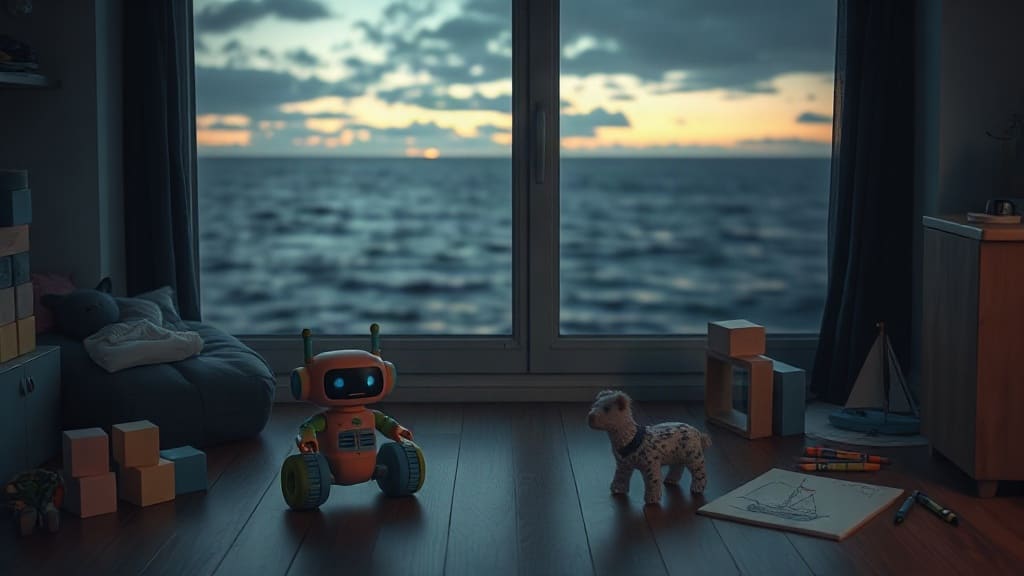
Imagine giving a child a shiny new toy that talks, responds, and even learns their name. Now imagine that same child, just ten minutes later, asking if they can throw it into the ocean. That's exactly what happened in a recent study that observed children playing with AI-powered toys. The findings are a wake-up call for an industry betting billions on artificial intelligence as the future of play. But the real story here isn't just about defective gadgets; it's about what children actually need from play, and why today's AI is failing them.
The Study: Three Stages of Disillusionment
Researchers designed a multi-stage play session with children aged four to eight. Each child was given a popular AI-powered toy, such as a smart robot or an interactive plush animal. The toys were marketed as responsive companions that could hold conversations, tell jokes, and adapt to a child's preferences. The study tracked engagement, emotional responses, and statements made by the children throughout the session.
In the first stage, children were curious. They asked the toys questions, tested their boundaries, and laughed at scripted responses. But by the second stage, cracks began to appear. Children noticed that the toys often repeated themselves, failed to understand context, or responded in ways that felt robotic. One child reportedly said, "It doesn't really listen to me. It just waits for its turn to talk."
By the third stage, the mood had shifted dramatically. Children became frustrated, bored, and even angry. Some began to treat the toys roughly, while others explicitly asked to stop playing. The most striking reaction came from a six-year-old who said, "I want to throw it in the ocean." That phrase became a recurring theme, with several children expressing a desire to discard the toys in a dramatic fashion. The researchers noted that the ocean comment wasn't literal but symbolic: the children wanted to get rid of something that had disappointed them.
Why AI Falls Short in Play
Play is not just about stimulation; it's about agency, imagination, and social connection. Traditional toys, from blocks to dolls, are open-ended. They allow children to create their own rules, invent scenarios, and project emotions. A teddy bear can be a patient, a superhero, or a confidant, depending on the child's whim. AI-powered toys, by contrast, are closed systems. They follow scripts, enforce predetermined interactions, and often interrupt a child's imaginative flow with irrelevant prompts.
The study highlighted a key issue: AI toys mistake responsiveness for engagement. They are designed to keep children occupied, not to enrich play. A child who wants to build a castle with blocks doesn't need a robot to comment on the weather. The constant chatter and need for attention from AI toys can actually hinder creative play, turning a child into a passive recipient of content rather than an active creator.
Another problem is the uncanny valley of conversation. Children are highly attuned to authenticity. When a toy claims to be a friend but responds with pre-recorded phrases, it feels fake. One child in the study said, "It's like talking to a broken radio." That disconnect between the toy's promises and its actual behavior leads to frustration. Children don't want a machine that pretends to care; they want a tool that empowers their own stories.
Industry Implications: A Market Correction Coming?
The toy industry has been pushing AI as the next big thing. Smart toys command premium prices, and manufacturers tout their educational benefits. But this study suggests that the value proposition is weak. If children reject these toys after a few minutes, parents will stop buying them. The market may be heading for a correction as early adopters share their disappointing experiences.
Some companies are already pivoting. Instead of trying to create a "friend in a box," they are designing AI that enhances traditional play. For example, an AI-powered building set might offer challenge suggestions without taking over the play. Or a plush toy might use AI to generate story prompts based on the child's actions, rather than forcing a linear narrative. The key is to keep the child in control and use AI as a subtle facilitator, not a dominant personality.
Investors and toy executives should take note. The study's findings align with a broader consumer backlash against overhyped AI in other domains, from smart speakers to virtual assistants. People are tired of technology that demands attention without delivering real value. In the toy aisle, that sentiment is even stronger because children have no patience for gimmicks.
The Ocean Metaphor: A Deeper Meaning
The children's desire to throw the toys into the ocean is more than a humorous anecdote. It reflects a fundamental mismatch between what AI promises and what it delivers. The ocean represents a vast, unpredictable, and creative space, the opposite of a scripted algorithm. Children instinctively understand that true play requires freedom, not constraint. When a toy tries to dictate the play, it becomes an obstacle to be removed.
This insight has implications beyond toys. It suggests that AI designed for children must be humble, context-aware, and genuinely responsive. It must know when to be silent. It must allow for messiness and ambiguity. Most importantly, it must not pretend to be something it's not. Children can forgive a toy that is simply a toy, but they resent a toy that claims to be a friend and fails.
What Parents Can Do Now
If you're a parent, you don't need to throw away your child's smart toys just yet. But you should be mindful of how they are used. The study recommends that AI toys be treated as occasional tools rather than primary playthings. Encourage your child to engage in open-ended play with traditional toys, art supplies, and outdoor activities. If you do buy an AI toy, look for ones that have an "off" switch for the smart features, allowing the toy to function as a normal object when needed.
Also, talk to your child about what they like and dislike about their toys. Their feedback is often more insightful than any market research. If they express frustration with a toy's limitations, validate that feeling and suggest alternatives. Remember that the best toy is often the simplest one, because it leaves room for the child's imagination.
The Road Ahead: Designing AI That Children Actually Want
The study's findings are a challenge to the tech industry: can you build AI that enhances play without hijacking it? Some researchers believe the answer lies in "invisible AI," where the technology works behind the scenes to support physical play. For example, a set of blocks might have embedded sensors that detect structures and offer gentle suggestions via a parent's app, not through a talking robot. Or a dollhouse might use AI to generate ambient sounds based on the child's actions, adding atmosphere without interrupting the story.
Another promising direction is child-led AI training. Instead of shipping toys with fixed personalities, companies could allow children to customize their toy's responses over time. This would give children a sense of ownership and make the toy feel more personal. However, this approach raises privacy concerns, as it would require collecting and storing data about children's interactions. Any such system must be transparent and secure.
Ultimately, the ocean comment should be a rallying cry for better design. Children are not Luddites; they embrace technology when it serves their needs. But they have no tolerance for technology that gets in the way of play. The toy industry must listen to its youngest critics and build AI that respects the child's imagination.
Frequently Asked Questions
What did the study find about children's reactions to AI-powered toys?
The study found that children's initial curiosity turned to frustration and boredom within minutes. By the third stage, many children expressed a desire to discard the toys, with one saying, "I want to throw it in the ocean." The toys' repetitive and scripted nature clashed with children's need for creative, open-ended play.
Why do children reject AI toys that are designed to be interactive?
Children are highly sensitive to authenticity. When a toy claims to be a companion but responds with pre-programmed phrases, it feels fake. Additionally, AI toys often interrupt imaginative play with irrelevant prompts, making children feel controlled rather than empowered. This leads to frustration and disengagement.
Are AI-powered toys bad for children's development?
Not inherently, but they can be if they replace traditional, open-ended play. Play is crucial for developing creativity, problem-solving, and social skills. AI toys that dominate the play session can limit these opportunities. Parents should balance AI toys with traditional toys and ensure that smart features can be turned off.
What should parents look for when buying an AI-powered toy?
Look for toys that allow the child to remain in control. Features like an "off" switch for smart functions, customizable responses, and a focus on enhancing rather than directing play are good signs. Avoid toys that constantly demand attention or claim to be a "best friend." Read reviews from other parents to see how children actually respond in real-world settings.
Will the toy industry change because of this study?
It's likely. The study provides concrete evidence that current AI toys fail to deliver lasting engagement. Companies that want to succeed will need to rethink their approach, focusing on subtle, child-led AI that supports rather than replaces traditional play. Expect to see more products that integrate AI invisibly or allow for customization.