
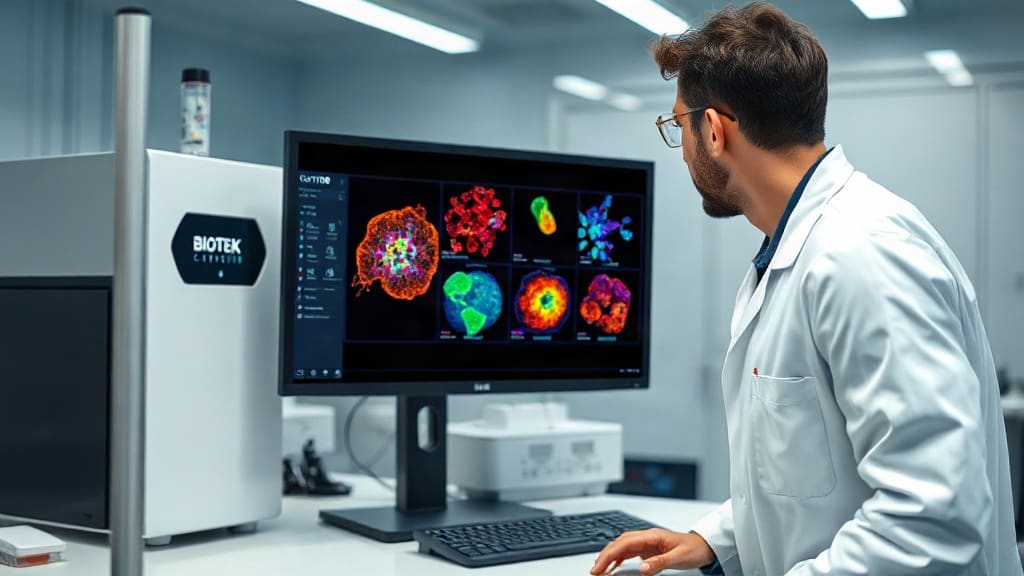
In the fast-paced world of life sciences, where every minute counts and accuracy is non-negotiable, Agilent Technologies has quietly rolled out a new software module that could change how researchers identify and analyze cells. The company, known for its analytical instruments and lab solutions, announced the launch of an AI-driven cell identification module for its BioTek Cytation imaging systems. While the press release might not have made headlines, the implications for drug discovery, cancer research, and clinical diagnostics are anything but trivial.
What Exactly Did Agilent Launch?
Agilent's new module leverages artificial intelligence to automatically identify and classify cells in microscopy images. Integrated into the Gen5 software that powers BioTek Cytation readers, the tool uses deep learning algorithms to distinguish between different cell types, assess their health, and even detect morphological changes that might indicate disease or drug response. According to Agilent, the module reduces the need for manual annotation, which is often time-consuming and prone to human error.
The company positions this as a step toward fully automated lab workflows. For researchers who spend hours peering into microscopes or clicking through images to mark cells, the promise of AI doing that heavy lifting is appealing. But does it deliver? Early adopters suggest that the module can cut analysis time by more than half while improving consistency across experiments.
Why Cell Identification Matters More Than Ever
Cell identification is a cornerstone of biological research. Whether you're screening thousands of compounds for anti-cancer activity, monitoring stem cell differentiation, or testing the toxicity of new chemicals, you need to know what cells you're looking at and how they're behaving. Traditional methods rely on manual gating or simple threshold-based algorithms, which struggle with heterogeneous populations or subtle phenotypic changes.
AI changes the game by learning from vast datasets of labeled images. Agilent's module, trained on millions of cell images, can recognize patterns that human eyes might miss. This is particularly valuable in high-content screening, where researchers generate massive image datasets and need to extract meaningful biological insights quickly.
The Shift Toward Automated Image Analysis
Agilent isn't the first to bring AI to cell imaging. Competitors like Sartorius, Thermo Fisher, and smaller startups have been integrating machine learning into their platforms for years. But Agilent's move signals that AI-powered analysis is becoming a standard feature, not a luxury. For labs with limited computational expertise, having a ready-to-use module embedded in existing software lowers the barrier to adoption.
How the AI Module Works Under the Hood
At its core, the module uses convolutional neural networks (CNNs) to process images captured by Cytation's brightfield and fluorescence channels. These networks are trained to segment individual cells, classify their type (e.g., HeLa, HEK293, primary neurons), and quantify parameters like size, shape, and intensity. The results are then fed into Gen5's analysis pipeline, allowing researchers to generate dose-response curves, calculate EC50 values, or flag outliers automatically.
Agilent emphasizes that the module is not a black box. Users can review and adjust AI-generated masks, providing feedback that fine-tunes the algorithm over time. This human-in-the-loop approach addresses a common concern in AI adoption: trust. By allowing researchers to validate and correct the AI, Agilent aims to build confidence in the technology.
Integration with Existing Workflows
One of the module's strengths is its seamless integration with Agilent's ecosystem. Labs already using BioTek Cytation instruments can upgrade without purchasing new hardware. The software update is available now, and Agilent offers training and support to help users get up to speed. For labs that rely on other imaging platforms, the module is not compatible, which might limit its appeal. However, Agilent's installed base is substantial, especially in academic and pharmaceutical research settings.
The Potential Impact on Drug Discovery and Development
Drug discovery is a numbers game. Out of thousands of compounds, only a handful make it to clinical trials, and fewer still gain approval. The earlier you can identify promising candidates and eliminate failures, the more time and money you save. AI-powered cell identification can accelerate this process by providing more reliable data on compound efficacy and toxicity.
For example, in phenotypic drug discovery, researchers look for compounds that cause visible changes in cells. Traditional analysis might miss subtle effects or require extensive manual review. Agilent's AI module can detect these changes with high sensitivity, potentially uncovering hidden gems that would otherwise be overlooked. Similarly, in safety pharmacology, the module can flag cytotoxic effects earlier, reducing the risk of late-stage failures.
Enhancing Reproducibility in Research
Reproducibility is a persistent challenge in biomedical research. Manual cell identification introduces variability between analysts and labs. By standardizing the analysis process, AI can improve consistency and make results more comparable across studies. Agilent's module includes features for batch processing and audit trails, which are essential for regulated environments like clinical trials.
Challenges and Limitations to Consider
No technology is without hurdles. AI models are only as good as the data they're trained on. If the training set lacks diversity, the module might perform poorly on rare cell types or unusual conditions. Agilent acknowledges this and encourages users to contribute their own annotated images to improve the model. However, this raises questions about data privacy and ownership, especially in industry settings.
Another consideration is computational demand. Running deep learning algorithms requires powerful GPUs, which may not be available on all lab computers. Agilent recommends using a dedicated workstation, which adds cost. For labs with budget constraints, this could be a barrier.
Competition and Market Landscape
Agilent's entry into AI-driven cell identification intensifies competition in the life science tools market. Companies like Sartorius (with its Incucyte platform) and Thermo Fisher (with its CellInsight systems) already offer AI-based analysis. Agilent's differentiator is its integration with the widely used Gen5 software and Cytation hardware, which are known for their flexibility and ease of use. By leveraging its existing customer base, Agilent can quickly gain traction.
What This Means for the Future of Lab Work
The launch of Agilent's AI module is part of a broader trend toward automation and digitization in life sciences. As labs generate more data and face pressure to do more with less, AI will become indispensable. We can expect future iterations to include predictive analytics, where the software not only identifies cells but also predicts how they'll respond to treatments. This could lead to virtual experiments, where AI simulates outcomes before any wet-lab work is done.
For now, Agilent's module is a practical tool that addresses a real pain point. It won't replace human expertise, but it can augment it, freeing researchers to focus on interpretation and discovery. As with any AI application, the key is to use it wisely, validate its outputs, and remain critical of its limitations.
Frequently Asked Questions
Is Agilent's AI cell identification module compatible with all microscopes?
No, the module is designed specifically for Agilent BioTek Cytation imaging systems and runs within the Gen5 software. It is not compatible with other brands of microscopes or imaging platforms.
How accurate is the AI compared to manual cell identification?
Agilent reports that the module achieves over 95% accuracy on common cell types, but accuracy can vary depending on image quality and cell type. It is generally more consistent than manual annotation, which is subject to human fatigue and bias.
Can I train the AI on my own cell types?
Yes, the module supports transfer learning, allowing users to fine-tune the model with their own annotated images. This helps improve performance for specialized or rare cell types.
Does the module require an internet connection?
No, the AI runs locally on your workstation. However, Agilent may offer cloud-based updates and support, which would require internet access.
What are the hardware requirements for running the AI module?
Agilent recommends a computer with a dedicated NVIDIA GPU (e.g., RTX 3060 or higher), at least 16 GB of RAM, and a multi-core processor. The exact specifications depend on the size of your image datasets.