
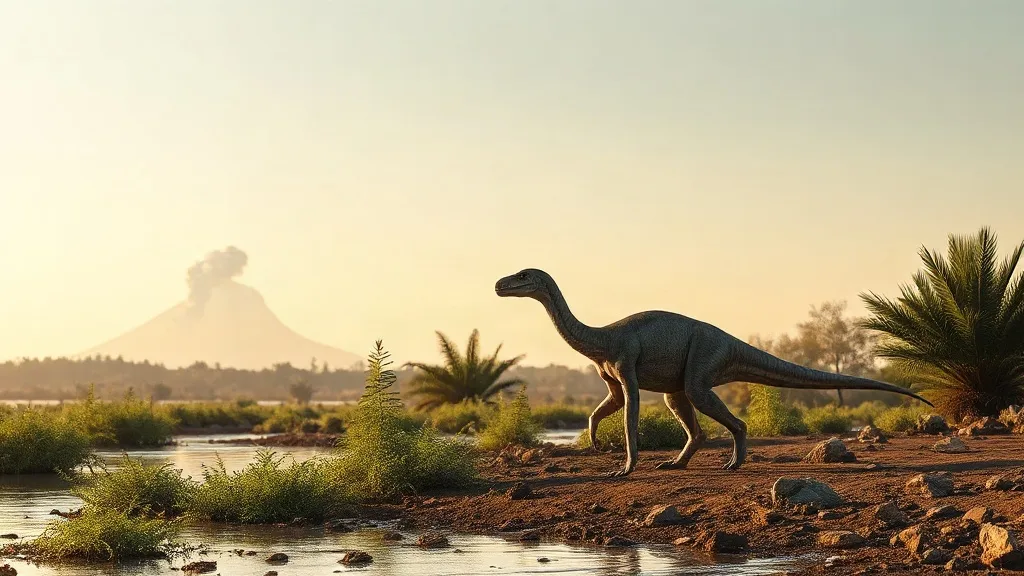
Paleontologists have unearthed a new dinosaur species in Zimbabwe that lived about 210 million years ago, during the Late Triassic. The find, announced this week, offers a rare glimpse into a prehistoric world that was far more diverse than previously imagined. The discovery suggests that ancient climate barriers may have split dinosaur populations across southern Africa, leading to the evolution of distinct species. This challenges long-held views that early dinosaurs were largely similar across the supercontinent Pangaea.
A Window into the Late Triassic
The new dinosaur, named Musankwa sanyatiensis, was identified from a partial skeleton including leg bones, vertebrae, and teeth. It belongs to a group called sauropodomorphs, which later gave rise to the giant long-necked dinosaurs. But this early relative was modest in size, likely around 1.5 meters long and weighing about 30 kilograms. Its discovery in the Mid-Zambezi Basin of northern Zimbabwe adds a crucial piece to the puzzle of early dinosaur evolution.
During the Late Triassic, all landmasses were joined as Pangaea. Yet the climate varied dramatically across this supercontinent. Southern Africa, then located near the southern polar circle, experienced cool, humid conditions with distinct wet and dry seasons. These environmental differences may have acted as barriers, isolating dinosaur populations and driving the evolution of unique species. The new find supports the idea that ancient climate zones shaped dinosaur biodiversity.
Why This Discovery Matters
Before this find, most Late Triassic dinosaurs were known from North America, Europe, and South America. African fossils from this period were scarce, leading to the assumption that dinosaurs on the southern continent were similar to those elsewhere. Musankwa breaks that pattern. Its anatomy differs from that of its contemporaries in other regions, hinting at a separate evolutionary path.
“This is a rare window into a lost world,” says Dr. Michel Zondo, a paleontologist at the Natural History Museum of Zimbabwe and lead author of the study. “It shows that southern Africa had its own distinct dinosaur fauna, influenced by local climate and geography.” The research, published in the journal Acta Palaeontologica Polonica, describes how Musankwa coexisted with other reptiles, including early crocodile relatives and plant-eating dicynodonts.
Unraveling the Ecosystem
The Mid-Zambezi Basin was a floodplain with rivers and lakes, surrounded by forests of seed ferns and cycads. Musankwa likely browsed on low-lying vegetation, using its small, leaf-shaped teeth to strip leaves. Its legs were adapted for walking on soft ground, and its tail helped with balance. Fossil evidence suggests it fell into a river and was buried quickly, preserving its bones.
Other fossils from the same site include a large carnivorous dinosaur, a smaller omnivore, and various small reptiles. This mix indicates a complex food web. The ecosystem was surprisingly rich, with dinosaurs occupying multiple ecological niches. The presence of several dinosaur species in one area suggests they partitioned resources, perhaps by eating different plants or living in different parts of the floodplain.
Implications for Dinosaur Evolution
The traditional view of early dinosaur evolution is that they originated in South America and spread globally. But Musankwa and other African finds challenge that. Instead, dinosaurs may have evolved independently in different regions, adapting to local conditions. This would mean that the path to the giant sauropods was not a single highway but a network of branching roads.
“We’re only scratching the surface,” says co-author Dr. Darlington Munyikwa. “Africa has vast, unexplored deposits that could rewrite the story of dinosaur origins.” The team plans to return to Zimbabwe for further excavations, hoping to find more complete skeletons and perhaps even eggs or nests.
The Bigger Picture: Climate and Evolution
This discovery isn’t just about one dinosaur. It’s about how climate shapes life. During the Late Triassic, the supercontinent was breaking apart, and sea levels were rising. These changes created new habitats and isolated populations, spurring evolution. Musankwa lived at a time when dinosaurs were still relatively rare, overshadowed by other reptiles. Yet they were already diversifying, setting the stage for their eventual dominance.
Understanding this ancient world can also inform modern conservation. As today’s climate changes, species are shifting their ranges and facing new competitors. Studying past ecosystems helps scientists predict how current biodiversity might respond. The Zimbabwe find is a reminder that life is resilient but also vulnerable to environmental shifts.
What’s Next for the Research
The team is analyzing the fossils in detail, comparing them with other Triassic dinosaurs to refine evolutionary trees. They are also studying the geology of the site to reconstruct the ancient environment more precisely. Future expeditions will target older and younger rock layers to trace how the ecosystem changed over millions of years.
For now, Musankwa sanyatiensis stands as a testament to Africa’s rich paleontological heritage. It’s a reminder that some of the most important chapters in life’s history are still buried, waiting to be discovered.
Frequently Asked Questions
What is the significance of the 210-million-year-old dinosaur discovery?
The discovery is significant because it provides rare evidence of a distinct dinosaur species in southern Africa during the Late Triassic. It suggests that ancient climate differences isolated populations, leading to unique evolutionary paths. This challenges the idea that early dinosaurs were uniform across Pangaea.
How does this discovery change our understanding of dinosaur evolution?
It supports the hypothesis that dinosaur evolution was more complex than previously thought, with regional variations driven by local environments. Instead of a single origin and spread, dinosaurs may have evolved independently in different parts of the supercontinent.
What other fossils were found alongside the new dinosaur?
Alongside Musankwa, paleontologists found remains of other dinosaurs, including a large carnivore and a small omnivore, as well as early crocodile relatives and plant-eating dicynodonts. This indicates a diverse ecosystem with multiple dinosaur species sharing the same habitat.
Why are African dinosaur fossils important?
African fossils fill a critical gap in the fossil record, which has been dominated by finds from North America and Europe. They help scientists test theories about how dinosaurs dispersed and adapted to different climates, offering a more global perspective on their evolution.
What can we learn from this discovery about modern climate change?
By studying how ancient ecosystems responded to climate shifts, scientists can gain insights into how current biodiversity might react to global warming. The isolation and diversification of dinosaurs during the Late Triassic mirror processes we see today as species migrate to escape changing conditions.